Disclosure: Feel free to share any part of this article on any website or social media — just please include a link to https://socialprofiler.com/blog/posts/2025-state-of-u.s.-social-media/. Thanks!
Introduction
Socialprofiler stores 5 billion social media profiles and 2 trillion connections between them (follows) in our database from four major platforms: Facebook, TikTok, Instagram, and X, out of which more than 756M profiles and 113B connections belong to U.S. users in total across all networks. For each network, the same amount of users were fully analyzed to produce this article.
Our state-of-the-art patented technology detects 350,000+ unique interests from broad to very specific; it’s hundreds of times more unique interests than any social media network itself, and therefore our data is much more insightful.
We utilized data from Facebook, TikTok, Instagram, and X, and you can see both how users’ interests vary from platform to platform and an aggregated picture, representing the entire user base of all major social media in the U.S.
This report is built based on the entire U.S. population and cross-checked against all social networks.
This report presents a comprehensive analysis of generational differences in social media engagement patterns, based on data collected from major platforms, including Instagram and X (formerly Twitter).
The study examines how different age cohorts—specifically Generation Z (18-27), Millennials (28-43), and older generations—exhibit distinct behavioral patterns across various dimensions of online activity, including hedonistic interests, political engagement, social network structure, financial behavior, and identity formation.
It should be noted that most of the graphs and pictures show Instagram, but conclusions are made based on all networks. If conclusions about trends are the same in other networks, then only Instagram is shown; otherwise, network comparisons are shown.
Key Findings:
Young women are becoming significantly more engaged with mature content and pornography than older generations, while young men show decreased interest in traditional hedonistic pursuits.
Young men are turning to Islam in larger numbers, and affects more on the younger generation, while traditional religions are giving up their positions.
Generation Z drinks substantially less alcohol than Millennials, with the decline particularly radical among young men.
The loudest political debates occur not among the youth, but among their parents and older siblings, who engage in traditional partisan politics; Gen Z focuses on social justice issues like LGBTQ+ rights and climate change rather than party rhetoric.
Old social justice movements are losing their audiences: Black Lives Matter lost a large percentage of followers who transitioned to non-political content.
Instagram functions as a set of “TV channels” for celebrity consumption rather than a community network—most users follow influencers and celebrities, not friends.
Older generations express hedonistic impulses through extreme sports and financial risk-taking, while Gen Z engages with social media content creation.
Conspiracy theories are more prevalent among older generations, while esotericism appeals to younger cohorts.
Older social media users demonstrate deeper engagement with mental health topics than Gen Z.
Social media platforms have developed distinct cultural roles: X dominates serious discourse (politics, science, news) with nearly 20% of Americans following Barack Obama on that platform alone; TikTok dominates entertainment and youth culture, with nearly one in six Americans following top entertainment creators; Instagram maintains visual/lifestyle niches.
Context observation:
The analysis reveals that generational stereotypes often contradict observed data, with significant implications for understanding how digital platforms shape and reflect social dynamics. The distribution of interests differs primarily between age groups, and in the following analysis, normalization to the demographic group under consideration is provided where appropriate, rather than absolute numbers.
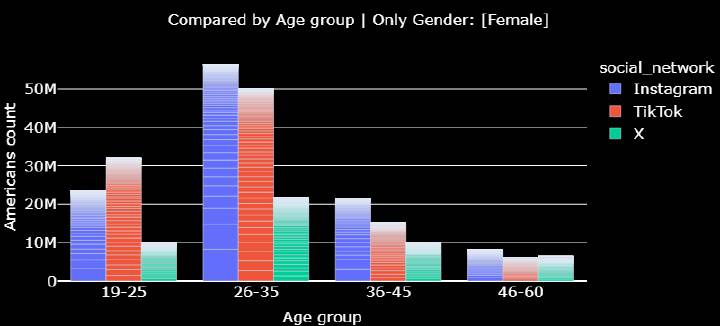
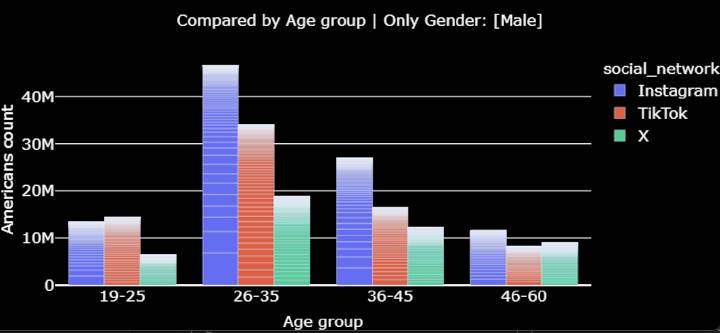
The demographic distribution shows that on the left graph are women and on the right are men; on both graphs, the x-axis represents age, and the y-axis represents absolute numbers. It can be observed that people aged 26-35 are the most numerous, with women outnumbering men. This observation shows a bias in social media audiences in favor of women and specific age groups. Even with normalization by gender or age, it is important to acknowledge that complete bias elimination is not possible, and one must always keep in mind that the data reflects the interests of people who use social networks, which may not represent the entire population.
Section 1: Hedonistic Interests Across Generations
This section examines hedonistic interests across different generations, with particular attention to how contemporary forms of hedonism may differ from traditional expressions. The analysis begins from the premise that modern hedonism, especially within Generation Z (Gen Z, ages 18-27), may be undergoing a fundamental shift from physical expressions of pleasure (such as intense sexual engagement or traditional “rock ’n’ roll” lifestyles) to a broader range of pleasures oriented toward comfort, self-expression, and instant gratification. While the prevailing stereotype suggests that younger generations engage more actively in hedonistic behaviors compared to older cohorts, this assumption warrants empirical examination.
The hypothesis proposes that contrary to popular stereotypes, Gen Z demonstrates significantly lower interest in traditional hedonistic topics—including pornography, BDSM, alcohol consumption, and party culture—when compared to Millennials (Gen Y, ages 28-43). This transformation suggests that generational differences in hedonistic behavior may reflect not only changes in intensity but also fundamental shifts in the forms and objects of hedonistic pursuit.
This hypothesis challenges the conventional narrative of “unrestrained youth” and suggests that generational differences in hedonistic behavior may be more complex than commonly assumed. The analysis examines mature content consumption, substance use patterns, and nightlife engagement across different age cohorts.
Evidence and Analysis
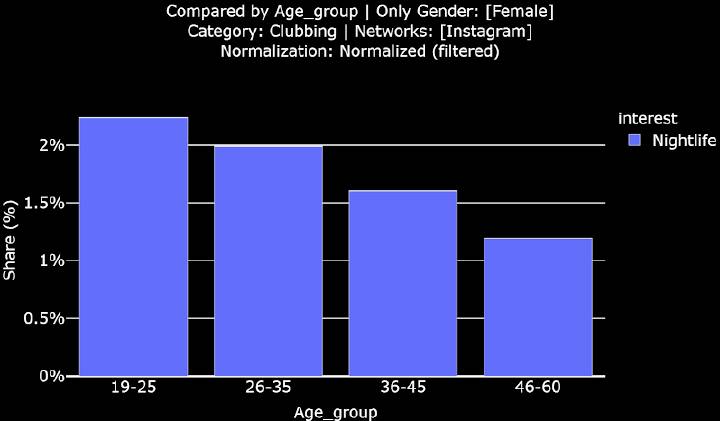
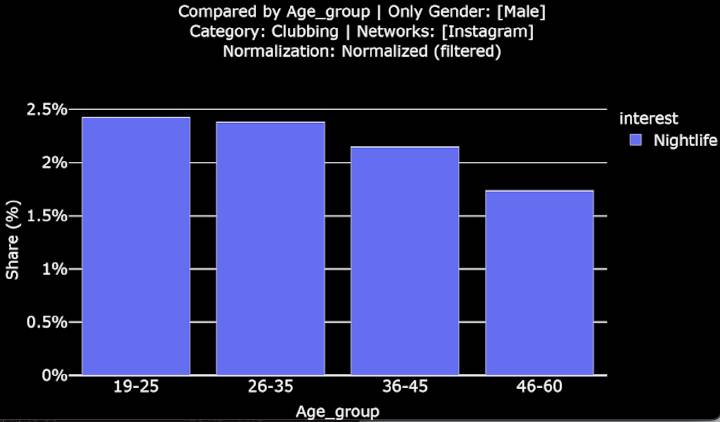
The investigation begins with an examination of nightlife and clubbing culture. When examining clubbing activities, the data reveals that in proportional terms, younger users demonstrate higher engagement, though surprisingly, older generations were not as far behind in interest as might have been expected.
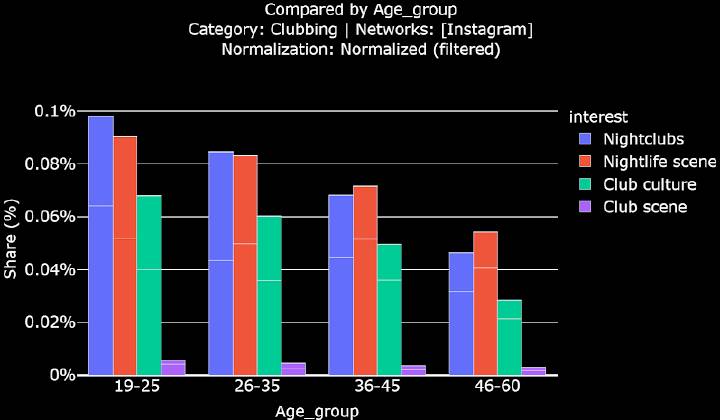
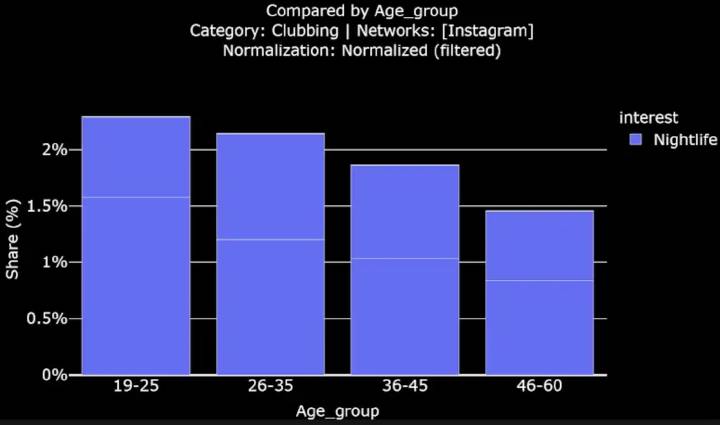
However, when examining the breakdown by the most significant interest category, it becomes apparent that the trend among women is more pronounced than among men, although young men still show greater overall interest in this activity.
Turning to alcohol consumption, the analysis examines hard alcohol preferences separately for women (left graph) and men (right graph).
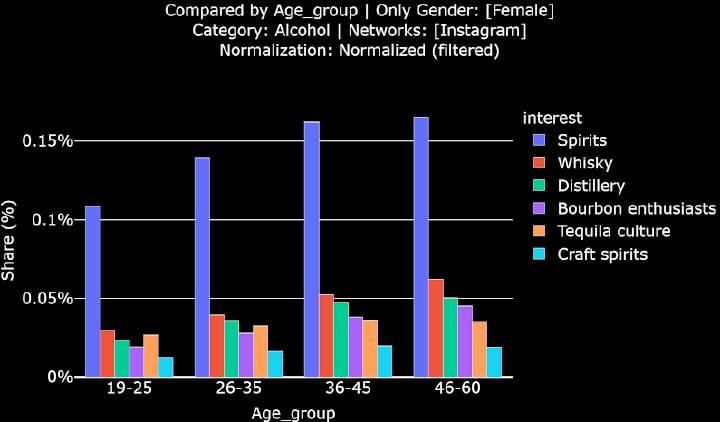
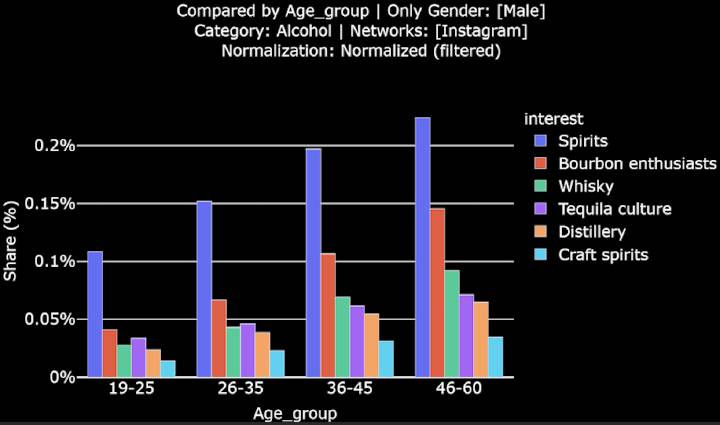
The data demonstrates that both Gen Z women and Gen Z men show less interest in alcohol consumption compared to older cohorts. This pattern holds true for the total sample as well, but the trend is more pronounced for men than for women. For women, the decline in interest is more moderate, while for men it is more radical.
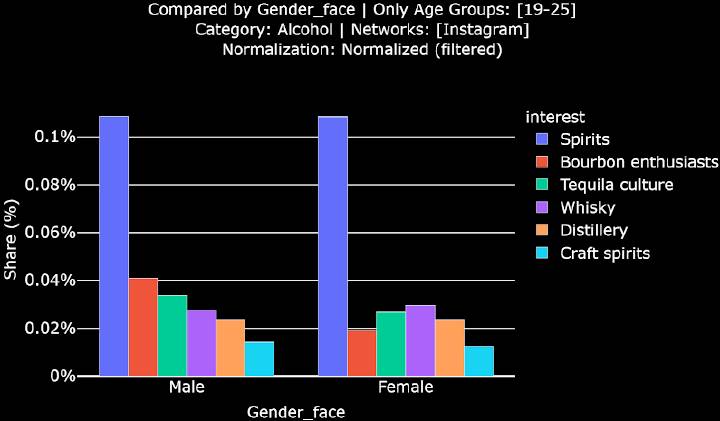
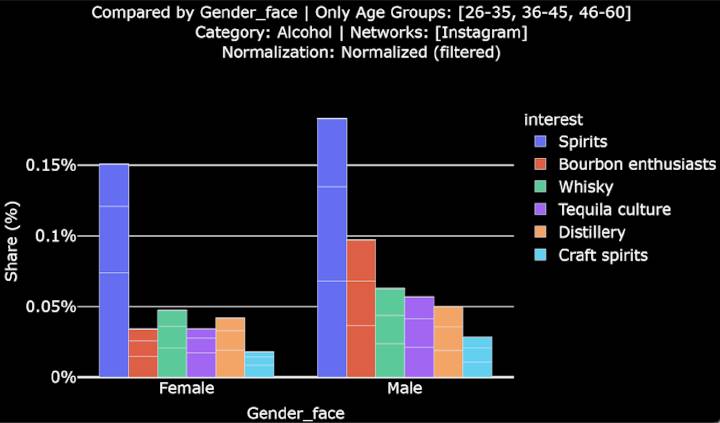
The data further reveals that for ages 19-25, interest in hard alcohol is nearly equivalent between men and women, while for older generations, men’s interest is more clearly visible and distinct.
Finally, the analysis examines mature content consumption, beginning with the social network X (while Instagram was previously the primary platform under consideration).
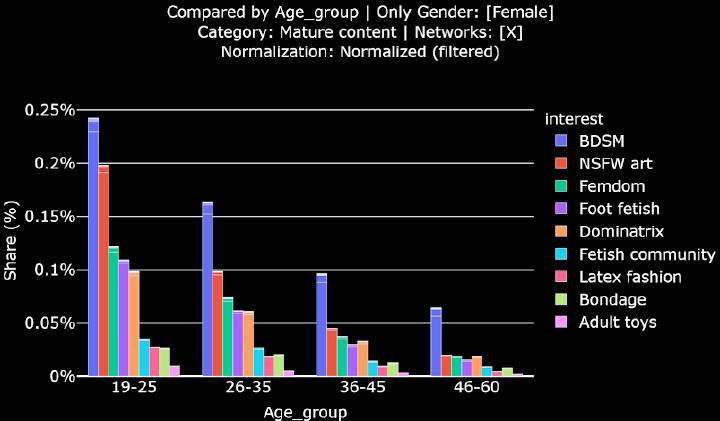
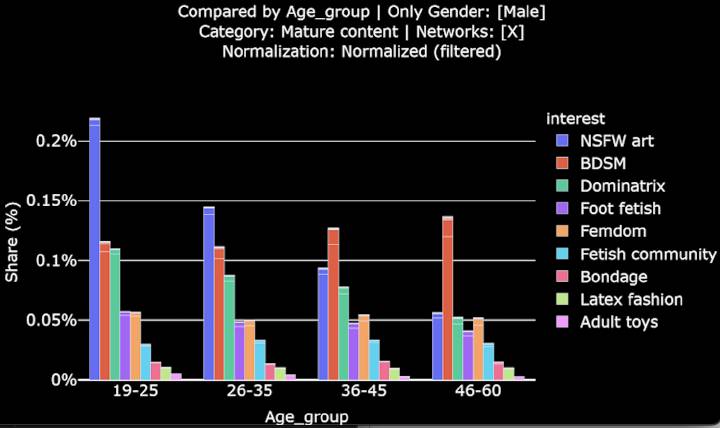
The findings reveal a complex pattern: young women are significantly more engaged in all selected mature content interests than older generations, while for men, the trend is rather the opposite or at least indicates stagnation, for most interests (except NSFW art). It should be noted that this analysis is conducted based on profile photos, with an attempt to clean duplicates—specifically photos sourced from the internet—and focuses on non-private profiles. Men may simply hide their interests more effectively through privacy settings, although the conclusions regarding young men’s behavior patterns repeat across other categories as well.
When considering men and women combined, it is evident that the younger generation is more engaged in this category than older generations.
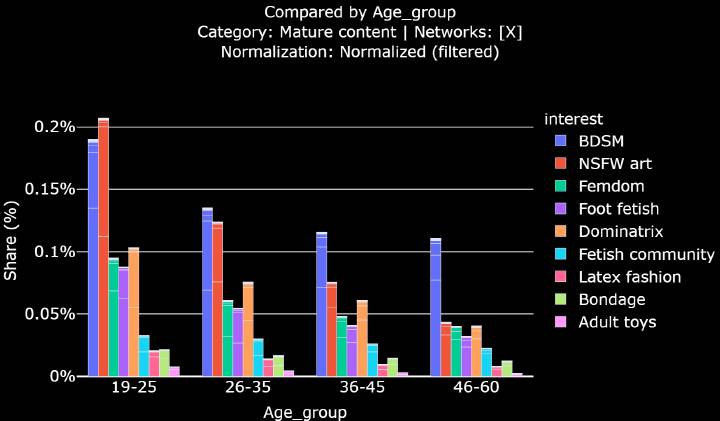
However, it can be concluded that this pattern occurs primarily due to the trend observed among young women.
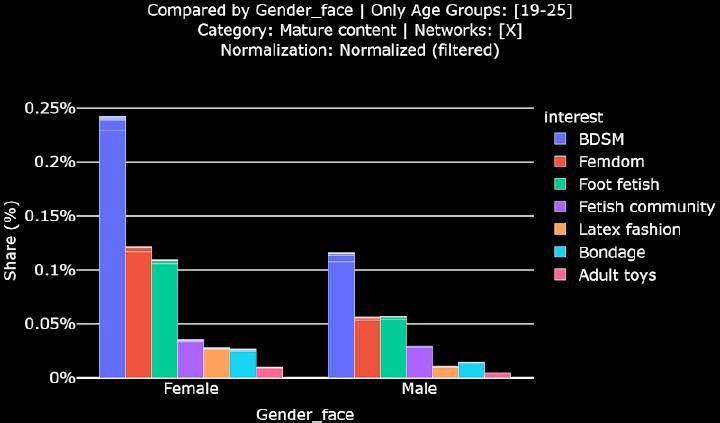
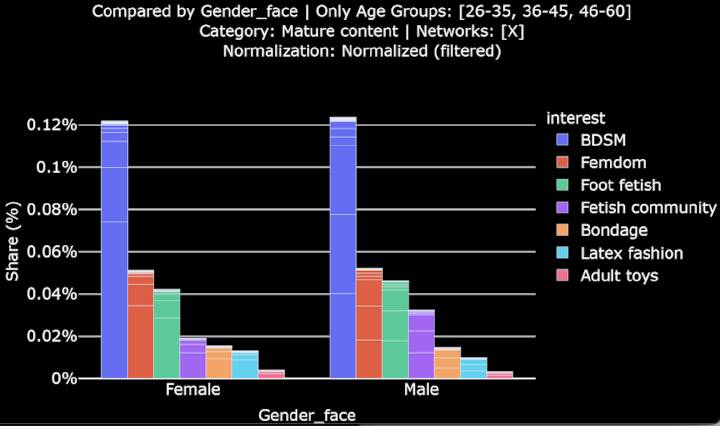
These gender-differentiated patterns in hedonistic engagement may reflect broader shifts in gender roles and masculine identity formation. From an anthropological perspective, contemporary masculinities are no longer rigidly fixed and unambiguous; men are increasingly required to adapt their roles in ways that contribute to a more amorphous masculine identity (see “masculinities as projects” in anthropological research; Cambridge Handbook of the Anthropology of Gender and Sexuality.
Gender Differences in Interest Categories
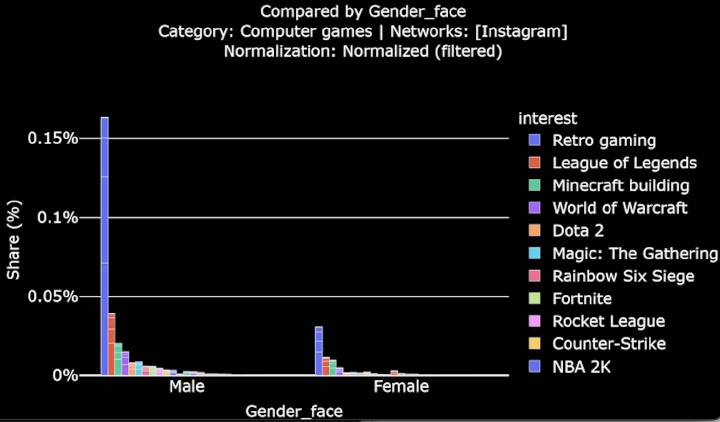
The analysis also examined which categories demonstrate predominantly male or female interest patterns. From a psychological perspective, as norms of male behavior soften or break down, men as a group may lose some of their former “rigid roles,” which may contribute to the observed patterns of reduced engagement in traditional hedonistic pursuits among younger men. In entertainment categories, men show significantly higher engagement.
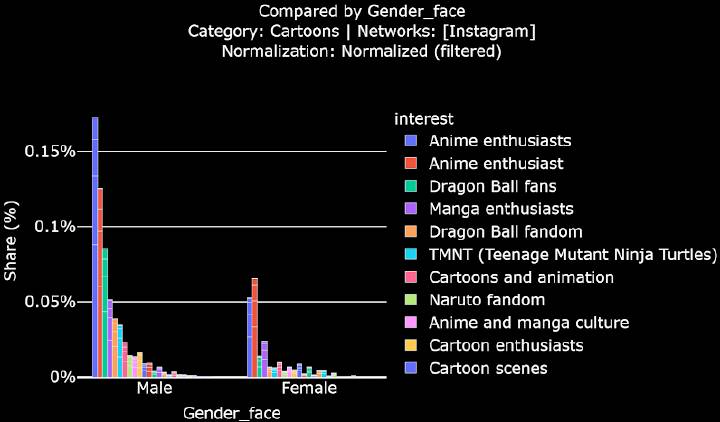
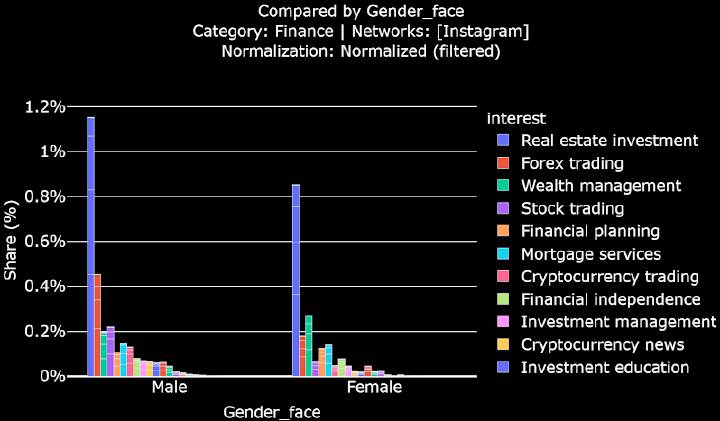
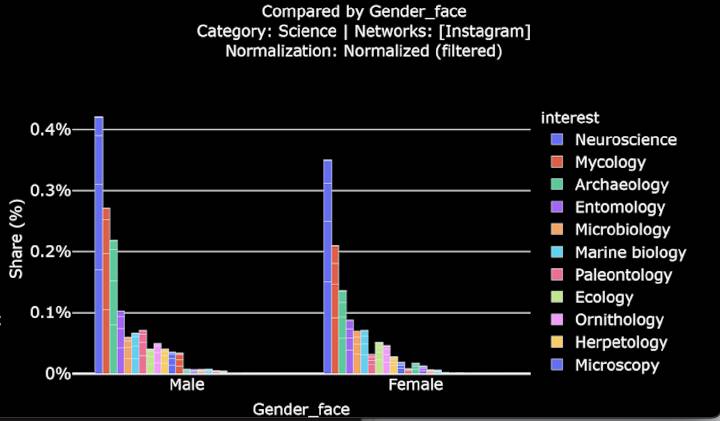
In areas of finance and science, men also lead in interest levels.
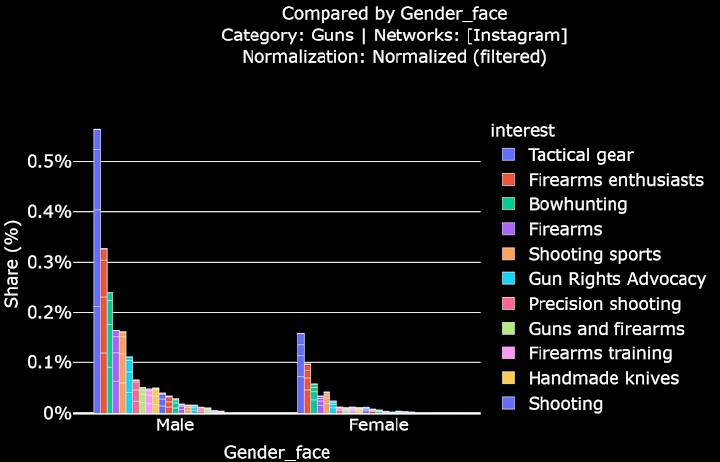
Finally, in categories related to firearms and sports, men demonstrate substantially higher engagement.
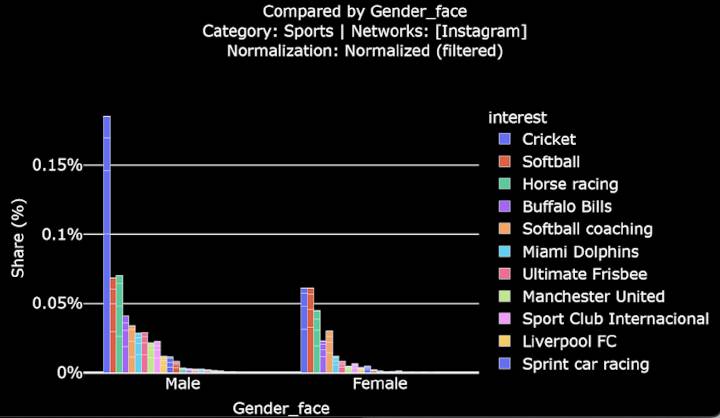
For many other categories, the trend favoring men or women varies depending on the specific interest, including traditionally more female-oriented interests such as the beauty sphere, though these categories are less central to the current analysis. This analysis of social network engagement patterns suggests that women may organize their networks differently—more diversified and resilient—compared to men, which can be argued to provide women with a competitive advantage in increasingly flexible social environments where traditional gender roles are less rigidly defined.
Conclusion
The evidence presents a nuanced picture of generational differences in hedonistic behavior. While Gen Z shows reduced interest in alcohol consumption compared to Millennials, their engagement with mature content, particularly among young women, contradicts the initial hypothesis. The data suggests that hedonistic behaviors are not simply declining across younger generations, but rather shifting in form and expression. The finding that Gen Z women show increased engagement with mature content while Gen Z men show decreased interest creates a gender-differentiated pattern that complicates simple generational narratives. These patterns may reflect broader social transformations in which men are becoming increasingly amorphous as traditional masculine roles become less rigidly defined. At the same time, women may benefit from organizing their social networks in more diversified and resilient ways, providing them with competitive advantages in increasingly flexible social environments.
Section 2: Political Engagement Patterns
The hypothesis is that Generation Z is not the most politically polarized generation on social media platforms. Instead, the highest interest in polar, “hot” politics is demonstrated by older users (Gen X and older Millennials), while Gen Z focuses on social issues such as climate change and LGBTQ+ rights without significant involvement in traditional party rhetoric or partisan political debates.
This hypothesis challenges the common assumption that younger generations are driving online political polarization. Instead, it suggests that Gen Z may be engaging with politics differently—through social justice movements rather than partisan party politics.
Evidence and Analysis
The analysis begins by examining how political engagement is distributed across different platforms. The Republican party category is much more represented across all platforms, but for comparative purposes, the analysis focuses on age group distributions on the X platform.
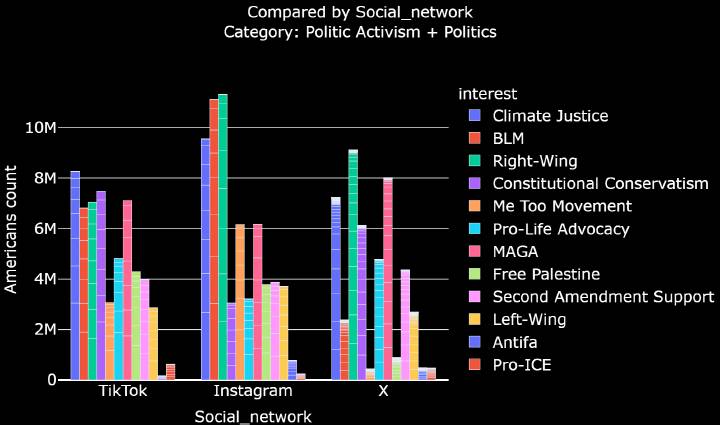
However, despite smaller overall reach, the left-leaning party category covers a younger demographic generation.
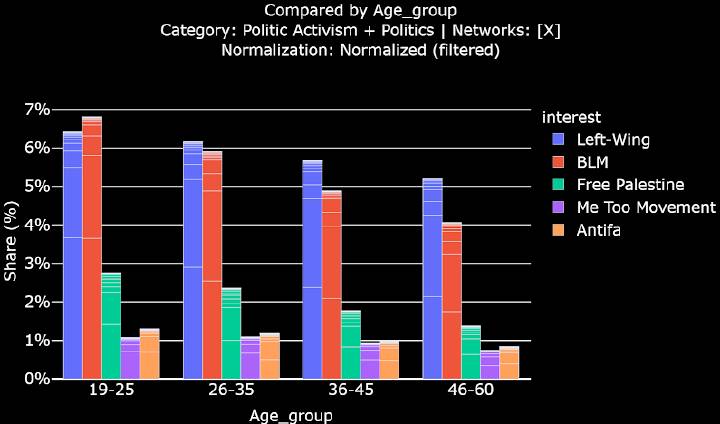
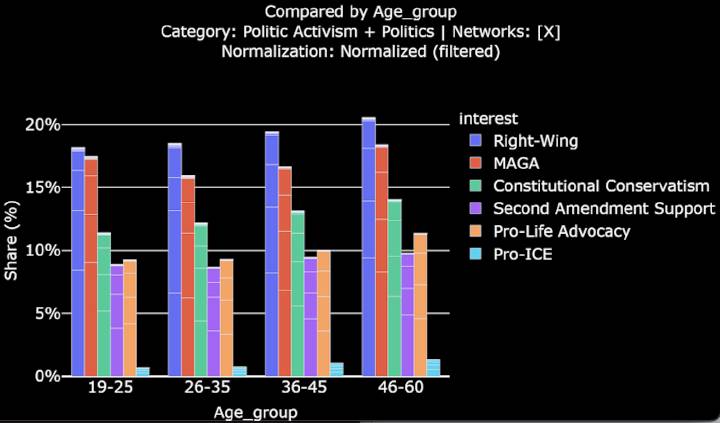
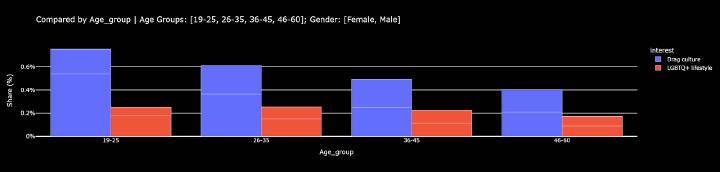
The same pattern holds true for interest in LGBT culture, where younger users show higher engagement.
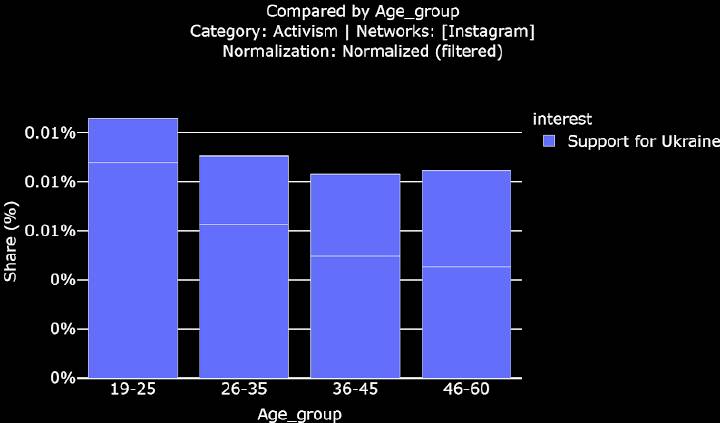
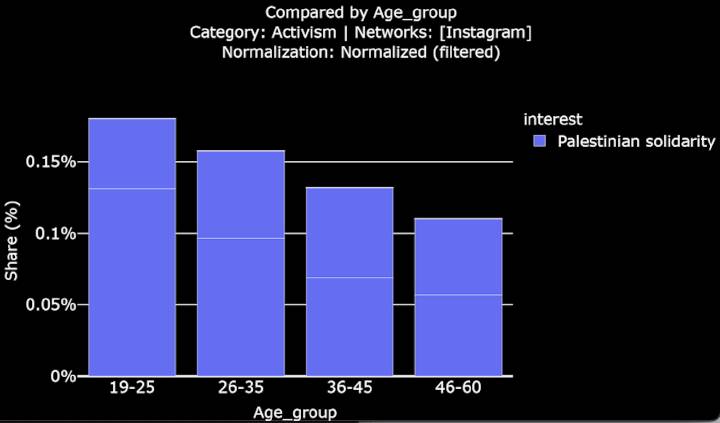
A similar pattern emerges for certain military-related issues, with age-based differences in engagement levels.
Temporal Dynamics of Political Activism
An additional analysis examines how political activism interests have shifted over time, based on blogger audience changes between early 2024 and October 2025. This temporal perspective provides insight into the evolution of political engagement patterns beyond static generational comparisons.
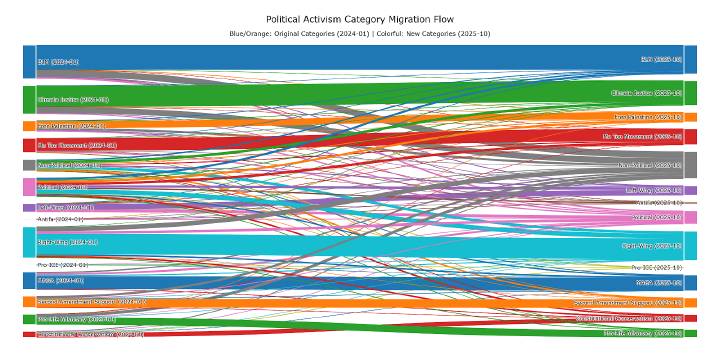
This graph shows the change in audience of political activism interests based on blogger classifications. On the left side are categories of political activism based on blogger information at the beginning of 2024 (despite the caption, the month may not be strictly January). On the right side is data from the 10th month of 2025. If there is a flow from a left activism category to a right category, this means that some number of bloggers with their audiences changed their content focus toward new activism categories. The size of the flows is proportional to the number of audience members affected.
The graph reveals that the Black Lives Matter (BLM) movement lost the largest share of its audience to Non-Political content. Under the “Political” category, the account is political, but not classified as strictly left or right learning. Under “Non-Political” is a transition to completely non-political content. For these two categories in the figure, only those parts are shown that have flow from or to other political activism categories—for example, non-political content clearly has a larger size than shown in the figure, as it represents a broader category that includes many accounts not transitioning from political activism.
It can be observed that overall, the BLM movement underwent a major reorganization, including a transition to other left activist movements, but also a significant transition toward non-political content. This suggests that engagement with social justice movements may be more fluid and transient than in traditional partisan politics, with substantial portions of audiences moving away from political activism entirely over time.
Conclusion
The data supports the hypothesis that Gen Z’s political engagement differs substantially from older generations. While Gen Z shows higher engagement with progressive social issues and left-leaning political content, older generations demonstrate stronger engagement with traditional partisan politics and party-affiliated content. This suggests that the loudest political debates occur not among the youth themselves, but among their parents and older siblings, who use social media platforms as spaces for ideological expression and partisan discourse.
However, the temporal analysis reveals an important nuance: social justice movements themselves may be undergoing significant reorganization, with substantial portions of audiences transitioning away from political activism over time. The finding that BLM lost a large share of its audience to non-political content suggests that, even among movements that initially attracted younger, politically engaged users, there may be a natural lifecycle or shift toward depoliticization. This temporal dynamic complicates the generational analysis, indicating that political engagement patterns are not static but evolve over time, potentially reflecting broader shifts in how social media users engage with political content.
Section 3: Anatomy of Social Network Structure
The fundamental question under examination is whether Instagram functions as a showcase for celebrities and influencers (essentially a set of “TV channels”), or as a network for friends and communities. The hypothesis is that Instagram primarily functions as a set of “TV channels” rather than as a community network. Most users subscribe to accounts with huge numbers of followers (celebrities, brands, influencers) and have very few mutual followings, resulting in a Followers Count to Follows Count ratio much less than 1.
This structural hypothesis suggests that Instagram is used primarily for passive consumption of content from “stars” rather than for active social interaction within peer communities.
Evidence and Analysis
The analysis reveals that in absolute numbers, the distribution of followings counts among Instagram users differs significantly from distributions observed in other social networks. Notably, Instagram has relatively few users with a small number of followings.
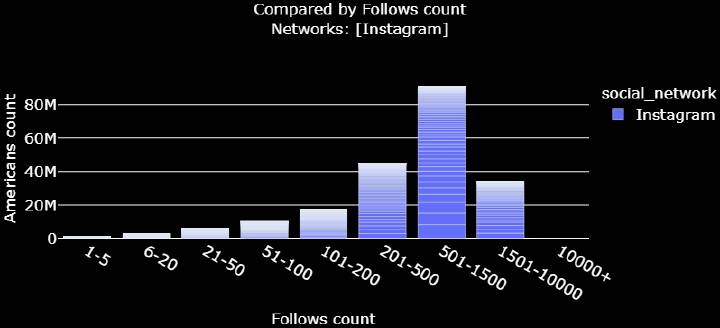
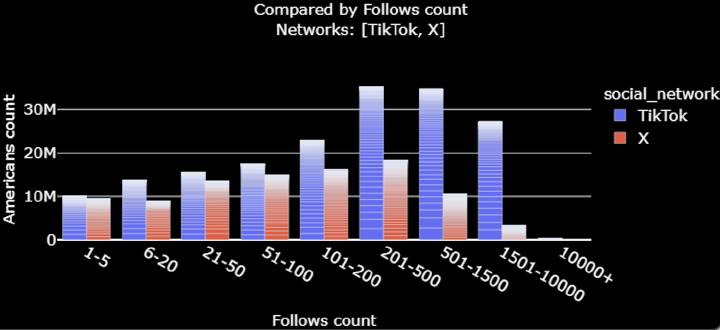
However, when examining the percentage of users who have a small number of friends versus those with a normal number of friends, the pattern appears more nuanced.
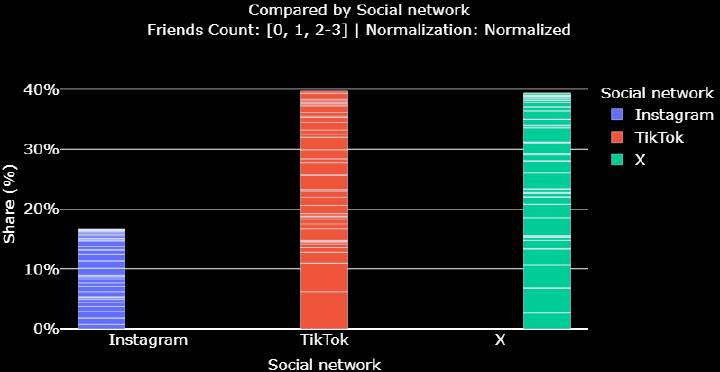
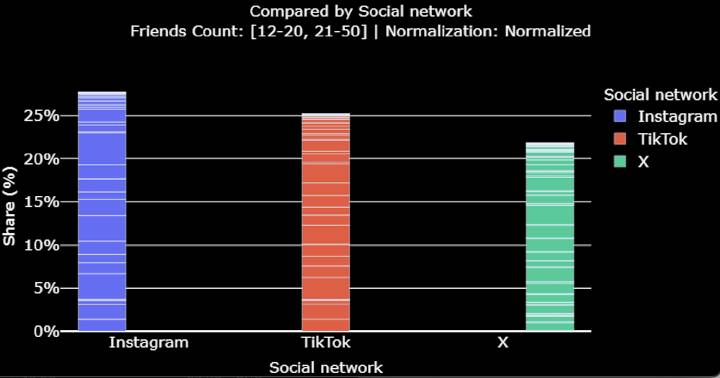
In absolute numbers, it can be observed that on Instagram, people tend to have a very large number of friends, with an anomalously large proportion having 101-300 friends.
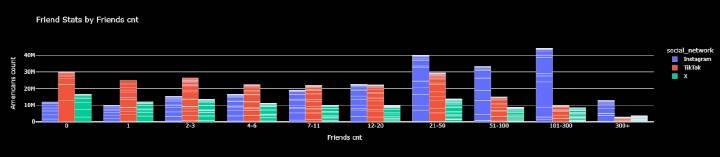
However, this pattern could be a consequence of Instagram users having a large number of followings overall.
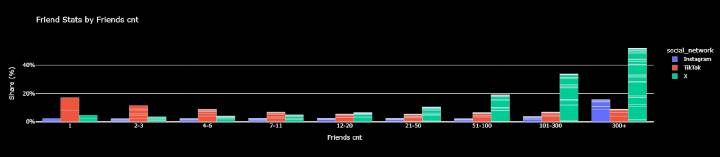
The critical analysis examines the percentage of followings that represent actual friends versus celebrity/influencer accounts. On the graph, it can be seen that for any number of friends (except super-high counts of 300+), Instagram shows the smallest percentage of people for whom these friends constitute a significant percentage of their total followings.
To understand this graph, consider the following example: fix the number of friends at a specific range, for example, 12-20 friends (these are three columns slightly to the right of the middle of the graph). The graph includes all people with this number of friends, which would represent 100% on the Y-axis. However, we added a filter that considers only those people for whom friends represent 40-100% of their total following. The percentage of friends is calculated as the ratio of the number of friends to the total number of followings.
As a result, on Instagram, such people represent approximately 0.02, or 2% of users with 12-20 friends. On TikTok, this proportion is slightly more than 5%. In general terms, on Instagram, friends make up a smaller percentage of followings, and people for whom friends are a significant percentage of their followings are fewer in number.
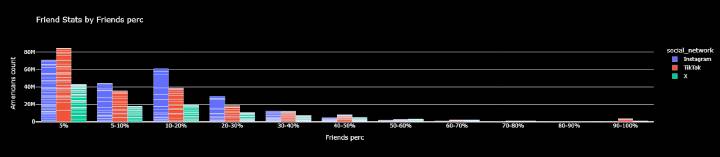
A similar conclusion can be observed by examining the following graph with absolute numbers, where it can be seen that Instagram users most often have a low percentage of friends relative to their total followings.
Conclusion
The evidence strongly supports the hypothesis that Instagram primarily serves as a platform for passive content consumption rather than active community building. The extremely low percentage of users for whom friends constitute a significant portion of their followings indicates that most Instagram users are engaging with celebrity and influencer content rather than maintaining peer-to-peer social connections. This structure aligns with the “TV channels” model, where users consume content from high-follower accounts rather than participating in reciprocal social networks.
Subsection: Private Accounts and Community Formation
A complementary hypothesis examines whether users with private accounts demonstrate different patterns of community formation. The hypothesis proposes that users with private accounts show a higher correlation of interests with their small circle of mutual friends compared to users with public accounts and their large number of followers. This would suggest that true communities form in the private sphere, away from public algorithmic curation.
Evidence and Analysis
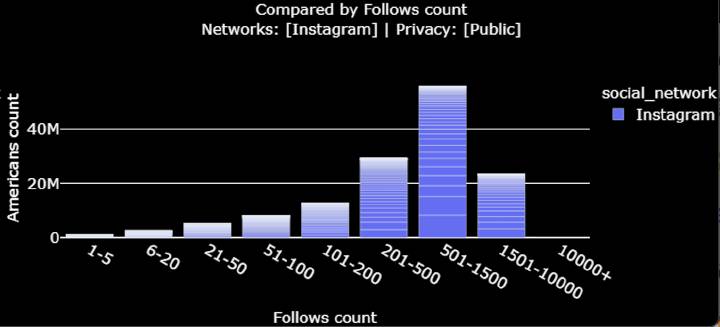
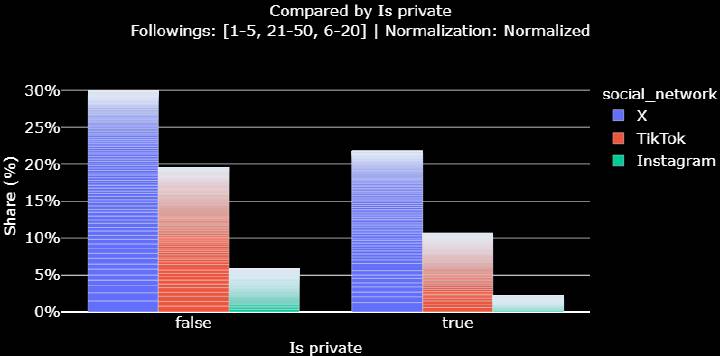
The analysis begins by examining the distribution of private accounts across different generations. Generation Y shows the highest proportion of private accounts, though the difference is not substantial.

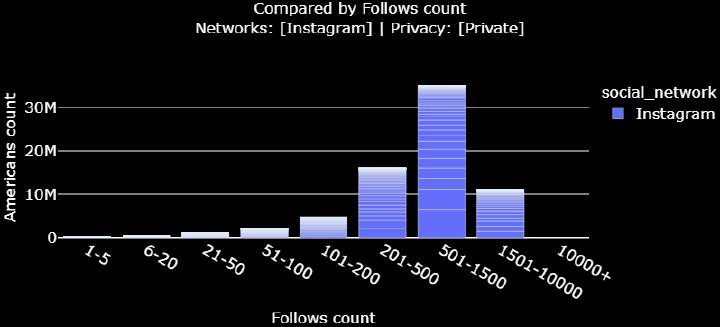
Overall, the distribution of followings counts is rather similar between private and public accounts. However, there is a slight difference: the proportion of private accounts with followings counts up to 50 (versus all private accounts) is greater than the same proportion for public accounts. This suggests that if a user makes their account private, they are more likely to use it actively for maintaining close connections.
Conclusion
While the data on private accounts is less conclusive, the slight difference in following patterns suggests that private accounts may indeed serve a different function than public accounts. Users with private accounts appear more likely to maintain smaller, more focused networks, potentially indicating stronger community formation in private spaces. However, further analysis of interest homogeneity and niche interest clustering would be needed to fully validate this hypothesis.
Platform Specialization and Top Creator Engagement
A complementary analysis examines which interest categories generate the highest engagement for top creators across different social media platforms. This analysis reveals how platforms have developed distinct cultural roles and content specializations, providing empirical evidence for the platform-specific consumption patterns discussed in the previous section.
Importantly, this analysis represents a portrait of the average American across different networks. The top interests identified in this study are determined by what regular Americans actually follow—measured as the average number of follows per interest across all Americans (where an individual may follow multiple creators within an interest category, so the mean can exceed 1). The top bloggers are measured as the percentage of all Americans who follow specific creators in each category. Rather than reflecting the preferences of content creators or platform algorithms alone, these patterns emerge from the collective choices of millions of ordinary social media users, making this data a reflection of mainstream American cultural consumption patterns across platforms.
It should be noted that the top creator analysis examines only the top creator per category per platform, measured as the percentage of all Americans who follow that creator. A category with a lower top creator percentage may still have significant overall engagement if many creators share the audience, rather than having a single dominant influencer.
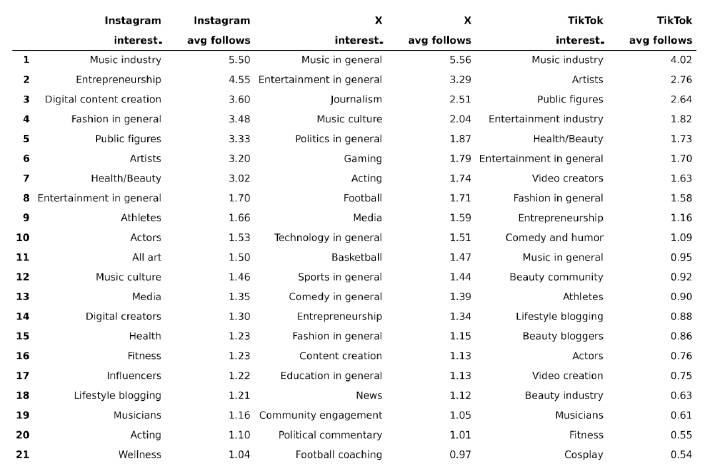
picture a1, Table showing top interest categories across Instagram, X (Twitter), and TikTok platforms. The table has three main sections (one per platform), each with two columns: “interest” (listing the category name) and “avg follows” (showing the average number of follows on a specific interest across all Americans - number of follows on interest can be > 1). The data reveals platform-specific content preferences and engagement patterns.
The analysis of the mean number of follows per interest reveals distinct platform specializations. On Instagram, music industry content leads with a mean of 5.09 follows per American, followed by entrepreneurship (4.65) and fashion (3.62), reflecting the platform’s identity as a visual space for creators and lifestyle brands. On X, music in general leads (5.76), but the platform shows a strong presence in professional categories, including journalism (2.59), politics, and technology, reflecting its dual nature as both an entertainment platform and a space for serious discourse. On TikTok, the music industry also leads (4.02). Still, the platform demonstrates substantial diversity across creative categories, including artists, video creators, and niche communities such as cosplay, underscoring its identity as a platform for creator-native content.
Politics
| Network | Follows % | Full Name | Link |
|---|---|---|---|
| TIKTOK | 2.38% | Logan Paul | Link |
| X | 19.64% | Barack Obama | Link |
| 3.45% | President Donald J. Trump | Link | |
| 0.49% | mittromney | Link |
Narcotics
| Network | Follows % | Full Name | Link |
|---|---|---|---|
| TIKTOK | 1.85% | Cheech & Chong | Link |
| 0.14% | HighTimesMag | Link | |
| 0.27% | High Times | Link | |
| X | 0.16% | FDA Drug Information | Link |
Science
| Network | Follows % | Full Name | Link |
|---|---|---|---|
| TIKTOK | 1.06% | Science Channel | Link |
| 2.85% | NASA | Link | |
| 0.36% | IFLScience | Link | |
| X | 15.86% | NASA | Link |
Entertainment
| Network | Follows % | Full Name | Link |
|---|---|---|---|
| X | 13.00% | The Ellen Show | Link |
| TIKTOK | 17.45% | JoJo Siwa | Link |
| 11.23% | Kim Kardashian | Link | |
| 1.59% | FamilyGuy | Link |
Beauty
| Network | Follows % | Full Name | Link |
|---|---|---|---|
| 4.80% | snoopdogg | Link | |
| X | 2.53% | James Charles | Link |
| 0.74% | bathandbodyworks | Link | |
| TIKTOK | 7.93% | Meredith Duxbury | Link |
LGBTQ+
| Network | Follows % | Full Name | Link |
|---|---|---|---|
| X | 0.64% | Elliot Page | Link |
| TIKTOK | 2.51% | Jax | Link |
| 0.42% | Niecy Nash | Link | |
| 0.06% | AuthenticTexan | Link |
Guns
| Network | Follows % | Full Name | Link |
|---|---|---|---|
| 0.34% | Gunsdaily™ | Link | |
| 0.43% | 2ndAmendmentSupporters | Link | |
| X | 0.67% | NRA | Link |
| TIKTOK | 0.66% | calebwfrancis | Link |
Erotic/Sexual Content
| Network | Follows % | Full Name | Link |
|---|---|---|---|
| 0.02% | CatsClassySeductions | Link | |
| X | 0.68% | Mia K. | Link |
Religion
| Network | Follows % | Full Name | Link |
|---|---|---|---|
| 0.93% | TrustGodbro | Link | |
| 0.55% | pages/Bible/104112892957168 | Link | |
| TIKTOK | 3.50% | China | Link |
| X | 2.82% | Dalai Lama | Link |
News/Media
| Network | Follows % | Full Name | Link |
|---|---|---|---|
| 1.03% | buzzfeedtasty | Link | |
| TIKTOK | 7.80% | Barstool Sports | Link |
| X | 9.59% | CNN Breaking News | Link |
| 9.92% | National Geographic | Link |
Activism
| Network | Follows % | Full Name | Link |
|---|---|---|---|
| 0.67% | AARP | Link | |
| 2.74% | Barack Obama | Link | |
| TIKTOK | 2.25% | Terry Crews | Link |
| X | 3.21% | Leonardo DiCaprio | Link |
Esoteric
| Network | Follows % | Full Name | Link |
|---|---|---|---|
| X | 0.65% | Zak Bagans 🧛🏻♂️ | Link |
| TIKTOK | 0.79% | Riot Addams | Link |
| 0.53% | SANCTUARY | Link | |
| 0.10% | GhostAdventures | Link |
In contrast to the mean follows analysis above, the following examination focuses on coverage—the percentage of all Americans who follow specific top creators in each category. This reveals dramatic platform concentration patterns. Politics demonstrates extreme platform concentration on X, with Barack Obama achieving 19.6% coverage—the single highest top creator coverage in the entire dataset—while political engagement on other platforms is minimal. This finding directly supports the earlier observation that X serves as the primary platform for political discourse, while other platforms show substantially lower political engagement.
The data reveals a 3:1 coverage gap between Republican and Democratic party top creators (1.18% vs. 0.42%), with Republicans dominating on X and Instagram. This pattern aligns with the generational analysis, showing that older generations engage more actively with traditional partisan politics, while Gen Z focuses on social justice issues rather than party rhetoric.
Entertainment shows TikTok dominance, with JoJo Siwa achieving 17.4% coverage—nearly one in six Americans following a single creator. This demonstrates TikTok’s power to create massive followings and supports the platform’s role as the primary entertainment hub for younger demographics. Beauty content shows platform migration, with TikTok (7.9%) overtaking Instagram (4.8%) as the beauty content hub, representing a shift in where beauty culture is created and consumed.
LGBTQ+ content demonstrates TikTok’s role as a safer space for marginalized communities, with 2.5% coverage compared to 0.6% on X, 0.4% on Instagram, and 0.06% on Facebook—a fourfold difference. This pattern suggests that TikTok’s algorithm and community norms better serve niche communities than traditional platforms.
Narcotics content shows surprising TikTok dominance (18.5% for Cheech and Chong), the second-highest single-platform coverage, while X shows minimal coverage (0.16%). This massive gap demonstrates how platform policies and culture shape content distribution: TikTok normalizes previously taboo topics, while X maintains stricter content policies.
Science content shows a strong X presence (15.9% for NASA), demonstrating how scientific institutions use social media for public engagement. Notably, NASA appears in multiple categories (Science, Travel), showing how one organization can serve multiple audience interests across platforms.
These findings reveal a fragmented social media landscape where each platform has developed distinct cultural roles: X dominates serious discourse (politics, science, news), TikTok dominates entertainment and youth culture, and Instagram maintains visual/lifestyle niches. This platform specialization suggests that Americans have developed a sophisticated understanding of which platform serves which purpose, leading to category-specific platform dominance rather than universal platform preference.
Section 4: Shifts in Hedonistic Expression
Financial Risk-Taking as New Hedonism
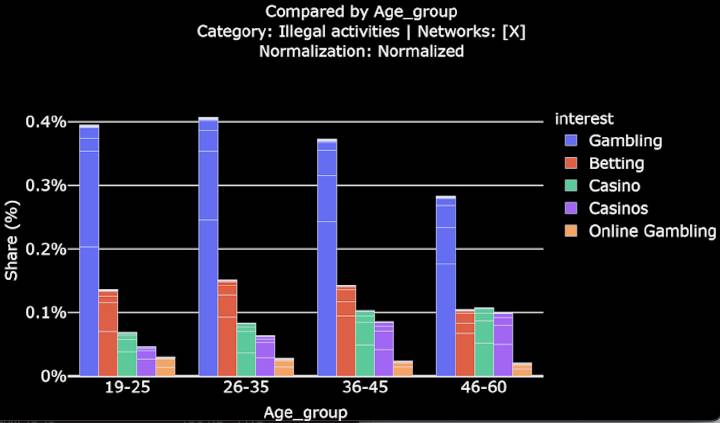
The hypothesis proposes that while Generation Z is interested in TikTok dances and social media content creation, Generation Y (ages 30+) demonstrates maximum interest in financial hedonism and risk-taking. Instead of traditional hedonistic pursuits like alcohol and parties, Millennials may be expressing hedonistic impulses through high-risk financial behaviors, including cryptocurrency trading, real estate investment speculation, online gambling, and penny stock trading.
Evidence and Analysis
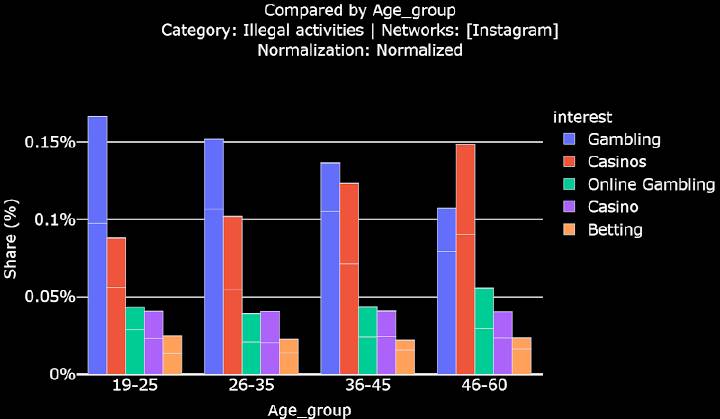
The analysis of gambling and risk-taking behaviors reveals nuanced patterns across platforms. When examining Instagram (left graph) and X (right graph), it can be seen that the data varies between platforms and specific interests. When normalized to demographic groups, users across age groups are approximately equally involved in casinos, gambling, and related activities on average.
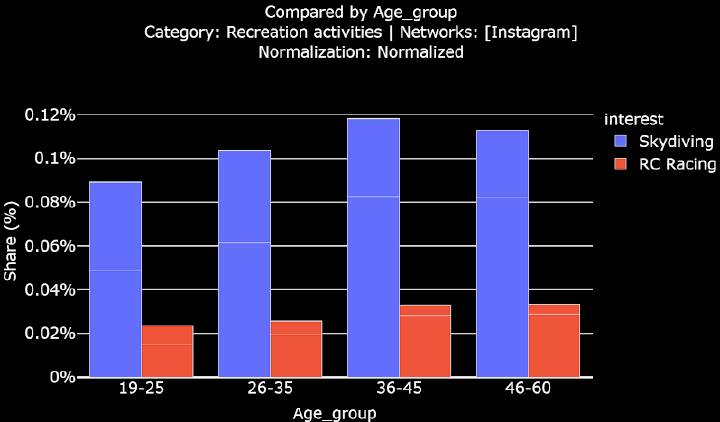
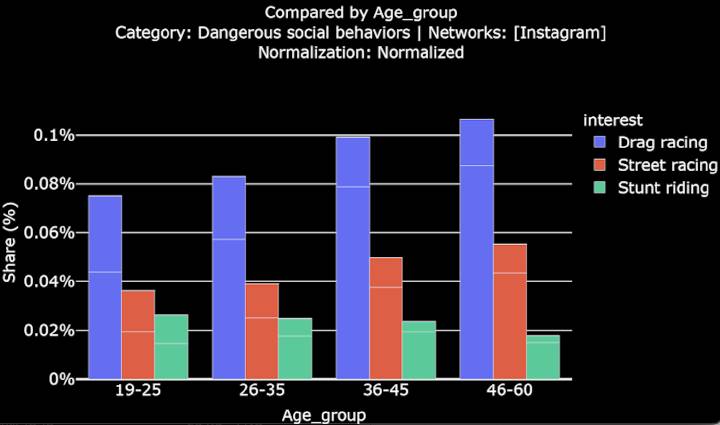
Regarding extreme sports, the trend appears higher among older generations rather than younger ones. This pattern may be related to financial resources, as older generations may have more disposable income to invest in extreme sports activities. Alternatively, it may reflect that older generations seek new experiences more than young people do, perhaps as a response to life-stage transitions.
Conclusion
The data presents a mixed picture regarding financial hedonism. While platform differences exist, normalized data suggests that risk-taking behaviors are distributed relatively evenly across age groups. However, the finding that extreme sports engagement is higher among older generations supports the broader hypothesis that Millennials may express hedonistic impulses differently than Gen Z, potentially through experiences and activities that require greater financial resources.
Escapism Through Religion and Conspiracy Theories
The hypothesis proposes that religious interests (traditional forms of escapism) and conspiracy theories (newer forms of escapism) demonstrate an inverse correlation with age. Specifically, traditional religious engagement may peak among older generations (ages 46+), while conspiracy theories and fringe beliefs may be more prevalent among younger or middle-aged cohorts.
This hypothesis suggests that traditional faith is being replaced not by scientific rationalism, but by other forms of metaphysical explanation of the world, including various conspiracy theories and esoteric beliefs.
Evidence and Analysis
The examination of religious movements reveals that only a part of religious movements are more popular among older generations.
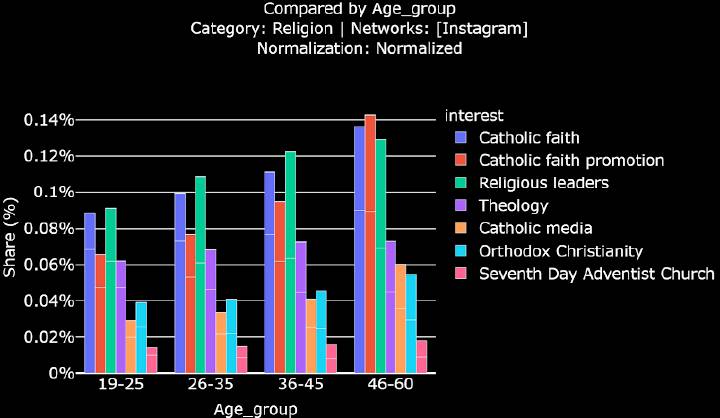
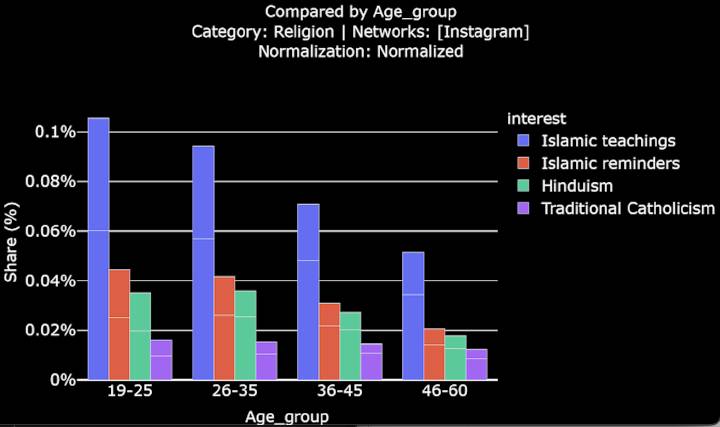
However, some religious movements, such as Islam, gain a larger percentage within the younger generation. This suggests that religious engagement patterns are complex and cannot be reduced to a simple age-based decline.
Regarding conspiracy theories and esotericism in general, more unambiguous conclusions can be drawn.
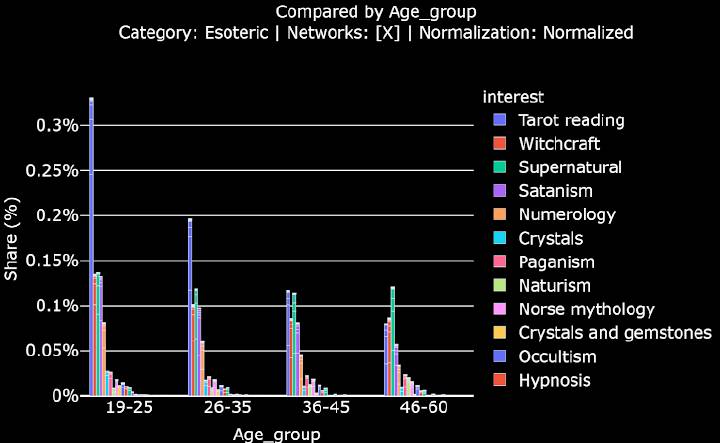
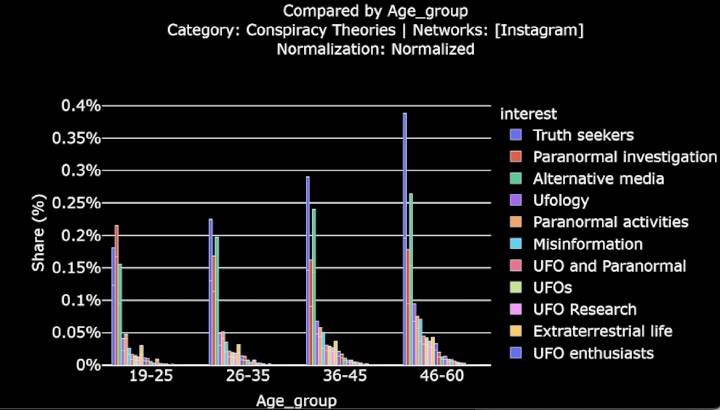
The data clearly shows that esotericism (on the left side of the graph) manifests more strongly among younger generations, while conspiracy theories are more prevalent among older generations. This creates an interesting distinction between different types of alternative belief systems and their generational distribution.
Conclusion
The evidence supports a nuanced version of the hypothesis: while traditional religious engagement shows mixed patterns across generations, alternative belief systems demonstrate clear generational differences. Esoteric beliefs are more common among younger generations, while conspiracy theories are more prevalent among older generations. This suggests that different forms of escapism and alternative worldviews appeal to different age cohorts, rather than representing a simple replacement of traditional faith with scientific rationalism.
Section 5: Economic Stratification Within Generations
The hypothesis proposes that the deepest divide on social media platforms runs not between generations, but within Gen Z and Gen Y along the axis of wealth versus frugality. The analysis should reveal two sharply contrasting groups of interests: one cluster representing hyper-ambitious consumption of luxury goods and status symbols, and another cluster representing survival anxiety and frugal living practices.
If these two interest clusters grow simultaneously within the same age groups, this would prove that social media reflects not a unified “generation spirit,” but increasing class stratification, where some users are preparing for luxury lifestyles while others are preparing for economic crisis.
Evidence and Analysis
The data presents an ambiguous picture. In the left graph, it can be seen that Gen Z is slightly more interested in topics related to saving and frugality, while the older generation is more interested in luxury consumption.
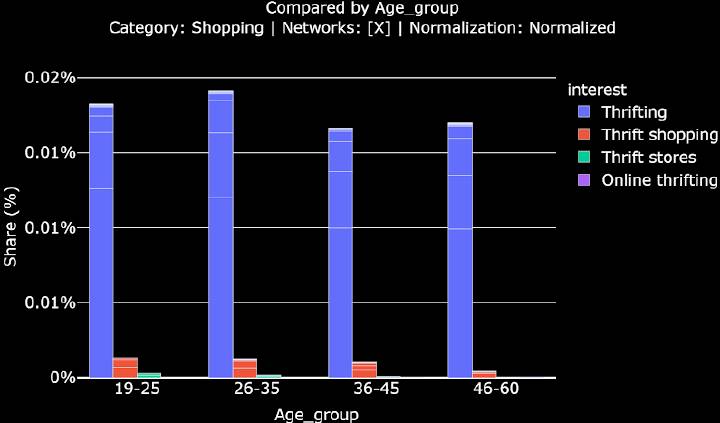
Further analysis confirms that luxury interests are rather characteristic of older generations.
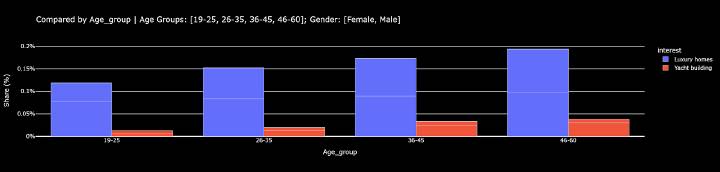
However, the conclusion remains not entirely obvious, because simple desires of people could be influencing the data, rather than their actual ability to afford these items. Both young and older generations may express interest in luxury goods regardless of their financial capacity to purchase them.
Conclusion
While the data shows some evidence of generational differences in luxury versus frugality interests, the findings are not as clear-cut as the hypothesis predicted. Gen Z shows slightly higher interest in frugal living topics, while older generations show higher interest in luxury consumption. However, the distinction between aspirational interest and actual economic behavior complicates interpretation. The data suggests some economic stratification patterns, but does not provide definitive evidence of the deep within-generation divides that the hypothesis proposed.
Section 6: Evolution of Identity and Gender Expression
The hypothesis proposes that interest in topics related to rigid external performativity—traditionally considered “toxic” manifestations of gender roles—decreases among Generation Z and is replaced by interest in mental health, psychological well-being, and the inner world. This would represent a shift from the “cult of appearance” to the “cult of psyche,” indicating a fundamental cultural transition from shame-based culture to therapy-based culture.
Evidence and Analysis
The analysis examines interest in mental health topics across different social networks. It appears that older generations demonstrate deeper engagement with mental health topics across all social networks.
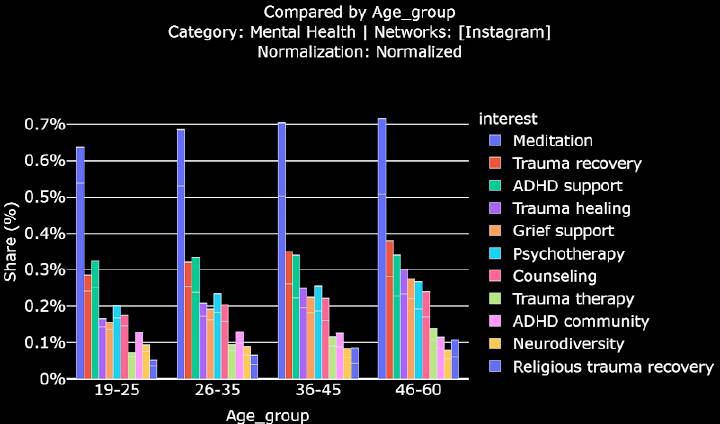
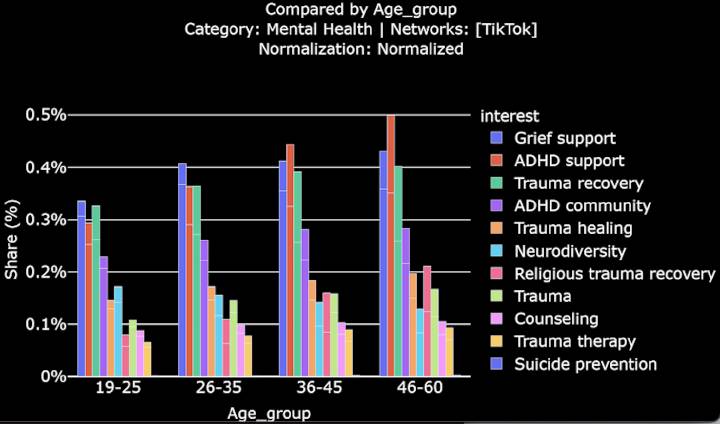
It appears that older generations on social networks are more interested in specific mental health topics (though for “Mental health awareness,” the trend is reversed; however, this is a rather general interest, and regarding any deeper engagement with mental health topics, interest increases with age).
However, this finding must be interpreted cautiously. The fact that older generation people who are on social networks are more interested in mental health topics may reflect selection bias: those older individuals who choose to use social media may be more health-conscious or psychologically aware than their peers who do not use these platforms. It may turn out that for those who do not use social networks, the trend is different.
Conclusion
The data contradicts the initial hypothesis that Gen Z would show greater interest in mental health topics. Instead, older generations demonstrate higher engagement with mental health content on social media platforms. However, this finding requires careful interpretation, as it may reflect selection bias among older social media users rather than true generational differences in mental health awareness. The hypothesis that Gen Z is transitioning from appearance-focused to mental health-focused identity formation is not strongly supported by the current data, though further investigation of specific therapeutic practices and mental health engagement patterns would be needed to draw definitive conclusions.
Overall Conclusion
This analysis reveals that generational differences in social media behavior are far more complex than common stereotypes suggest. The data demonstrates that:
Hedonistic behaviors are not simply declining among younger generations, but rather shifting in form and expression, with notable gender differences.
Political engagement patterns differ substantially between generations, with Gen Z focusing on social issues rather than partisan politics. However, temporal analysis reveals that social justice movements may undergo significant reorganization over time, with substantial portions of audiences transitioning away from political activism entirely, suggesting that political engagement patterns are dynamic rather than static.
Social media platforms, particularly Instagram, function primarily as content consumption networks rather than community-building spaces, though private accounts may serve different functions.
Financial risk-taking and alternative belief systems show complex generational patterns that cannot be reduced to simple age-based trends.
Economic stratification within generations may be developing, though the evidence is not definitive.
Mental health engagement appears higher among older social media users, though this may reflect selection bias.
These findings challenge simplistic generational narratives and suggest that social media behavior reflects complex interactions between age, gender, economic status, and platform structure. Future research should continue to examine these patterns with larger datasets and more sophisticated analytical methods.
Disclosure: Feel free to share any part of this article on any website or social media — just please include a link to https://socialprofiler.com/blog/posts/2025-state-of-u.s.-social-media/. Thanks!